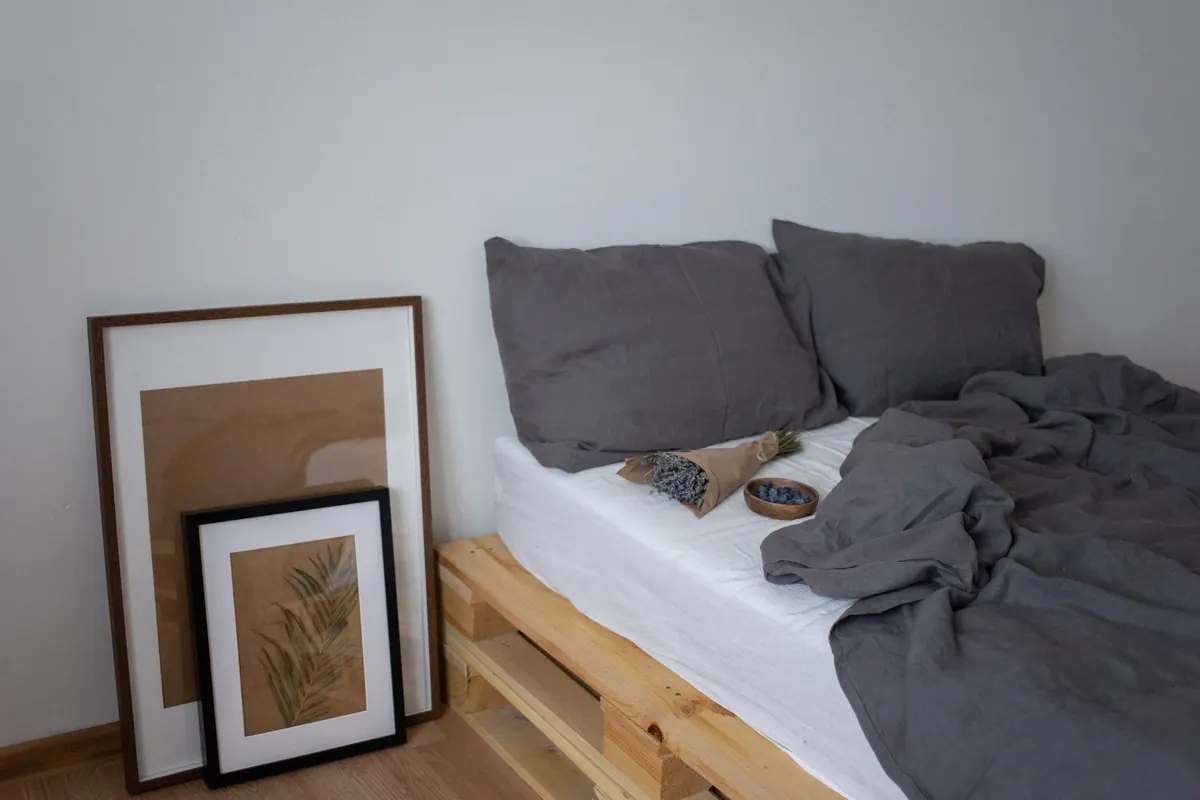
A cottage bedroom is rarely furnished in one go. It accumulates: a quilt found at a market, sheets softened by years of washing, a knitted blanket someone made, a cushion bought on a whim. Each piece is good on its own. Put all of them on the bed at once and the room starts to look like a linen cupboard that fell over.
The difference between collected and cluttered isn't taste. It's arithmetic and editing. Layering works when you know how many layers you're allowed, which textures flatter each other, and what to take away when the bed starts to feel busy.
Everything else on the bed is negotiable. The sheets are not. They're the layer your skin meets, and the colour that the quilt, blanket, and pillows will all be measured against.
Pick one fabric and one colour, then stay with it. Washed linen is the natural cottage choice: it breathes, it crumples in a way that looks intentional, and it improves with every wash. If you prefer something crisper, cotton percale does the same job with a cooler hand. Either way, keep fitted sheet, flat sheet, and pillowcases in the same family — white, oatmeal, faded blue, soft sage, warm grey.
Resist patterned sheets. A printed sheet fights with a patterned quilt, and the eye has nowhere to rest. Solid sheets give everything above them room to speak.
Weight matters as much as colour. Heavy flannel under a heavy wool blanket is a bed you can't turn over in. If your sheets are thick and brushed, keep the top layers light.
Three full-width layers is the ceiling on a double or queen bed. Four on a king, and only if the fourth is folded rather than spread.
Anything beyond that should be folded at the foot of the bed rather than pulled up over the pillows. A stack of two folded quilts reads as a collection. The same two quilts spread across the bed read as a muddle. This is the single most useful rule in the room, and the one most people break first.
Layered is not the same as crowded. The difference is whether you can still see what you started with.
In July, the middle layer can disappear entirely — sheets and a folded coverlet at the foot are plenty. In January, swap the cotton quilt for wool and add a throw. Rotate rather than add. A blanket stored in a chest in summer feels new again in October, and the bed never grows heavier than the room can carry.
Fabrics that match too closely go flat. You want surfaces that differ but weights that sit in the same range.
What fights: two shiny fabrics, two heavy textures, or a busy quilt plus a busy throw plus a patterned cushion. Choose one piece to be the interesting one and let the rest behave.
Pillows undo more cottage bedrooms than bedding does. Work in rows and count as you go.
On a single bed, use one back pillow, one sleeping pillow, one small front cushion. And follow the same discipline as the covers: if you add one, take one away.
Choose the anchor from something already in the room — a rug, a painting, the paint on the walls. If the walls are faded blue-grey, keep sheets oatmeal, the quilt blue, and let one small cushion carry a soft brick red. Three tones is usually enough; four starts to look like a jumble sale.
Pattern works the same way. One large-scale pattern, one small, and everything else plain. Two patterns of the same scale next to each other always look like a mistake, even when the colours are perfect.
Two or more of those and it's time to pull one thing off and put it in the chest. Collected rooms are edited rooms.
Linen is supposed to crease. Quilts are supposed to show their stitches and their mended corners. A cottage bed that looks lived in beats one that looks staged, and chasing a hotel finish will only make you miserable on a Sunday morning.
Make the bed loosely: pull the sheet up without ironing it, fold the top layer in thirds, and let the pillows sit rather than stand to attention. Keep a basket or a trunk nearby for whatever is out of rotation, so the pieces you love have somewhere to live between seasons. The bed will look better for it, and so will the room.
Photo: KATRIN BOLOVTSOVA / Pexels

Spot genuine antique cottage furniture by reading the wood, joinery, patina, hardware and price — and learn the...

Choose the right herbs, prep a box that drains properly, and a windowsill can supply fresh leaves all winter — even...

Two pantry-friendly methods — stovetop simmer pots and homemade linen sprays — fill a cottage with warm bakery...

Cozy cottage living, decorating, and inspiration.